The Claim and the Proof Are Not the Same Thing
Claim and proof are not interchangeable: learn to check what a source actually establishes, what it leaves open and which details need verification.
A council notice can confirm that a meeting was scheduled without confirming what officials decided there. Claim and proof are not interchangeable: the useful question is what a source lets you verify, and what it leaves unanswered.
That distinction is especially helpful when a news report links to documents, images or recordings. Rather than treating a source as a stamp of approval, inspect what it is, where it came from and what part of the story it can illuminate.
What kind of source is this?
Start with the item itself. A council agenda, a court filing, a photograph and a resident’s account are different kinds of sources, with different limits. An agenda records what was scheduled; it does not necessarily record what happened. A filing records what a party submitted; it is not, by itself, a court’s finding.
Check who created the material, when it was created and how it reached the report. A document hosted on an official council site may be easier to trace to its origin than a cropped image passed between accounts. But official origin does not make every interpretation of the document sound.
Think of a source as a label on a storage box: it can tell you what is inside, but not whether someone has described the contents accurately. Keep the source and the claim about it separate.
What can the source establish?
Use the source to answer a precise question. Does the notice contain a date? Does the recording include a particular sentence? Does the table list a named location? These are narrower questions than whether a policy worked, a person intended harm or an event had a particular cause.
Read or view the relevant material yourself where practical. Check dates, names, definitions and surrounding passages. A quotation may be accurate but omit the sentence that qualifies it; a table may be correctly reproduced yet cover only a subset of the places named in the report.
Keep a short record of what you can point to in the source, rather than writing down only the report’s interpretation. If the source supports just one part of a larger story, that is still useful information. It simply should not be asked to carry the rest.
How do you check a source’s context?
Context means the conditions that help explain what an item says and what it does not say. For a document, that may include its author, purpose, date and the records around it. For an image, it may include its original caption, location and whether the image has been cropped or reused.
Ask whether the source is complete, current and relevant to the claim. A page may be an archived version; a recording may begin after the exchange in question; a public statement may describe a policy rather than its effects. These limits do not make the material worthless. They define what it can reasonably support.
Separate direct evidence from interpretation. A recording can establish that words were spoken, while a claim about the speaker’s intention needs further support. A notice can establish that an interruption was announced, while accounts or service records may be needed to establish what residents experienced.
Which source checks should you make?
Use these checks before relying on a source. Each one ends in a decision: keep the item for the point it supports, seek a better source, or leave the claim unresolved.
- Origin: Check whether the item links to its original publisher or creator. If you can trace it to an original document or recording, use that version; if you cannot, treat the copy as unverified and look for an attributable source.
- Date: Check the creation or publication date against the period in the claim. If they match, assess the item for that period; if they do not, find a source from the relevant period or state that the timing is unclear.
- Completeness: Check whether the cited passage, image or recording is presented in full enough to understand its context. If important surrounding material is available, inspect it; if it is missing, avoid relying on an interpretation that depends on it.
- Scope: Check which people, locations and events the source actually covers. If it covers the same scope as the claim, consider it relevant; if it covers less, narrow the claim or seek material that covers the omitted ground.
- Purpose: Check whether the source records an event, makes an argument, promotes a position or reports personal experience. If its purpose fits the point being made, use it with that purpose in mind; if it does not, seek a source suited to the question.
- Corroboration: Check whether another independent source supports the same specific detail. If it does, confidence in that detail may reasonably increase; if it does not, keep the point provisional and look for another account or record.
How do you check a source without overstating it?
How can you trace a document to its origin?
Follow the report’s link to the publisher and check the title, date and document itself. If the link leads only to a quotation or an unexplained image, search for the original record; if you cannot locate it, describe the source as unverified.
What does a photograph prove?
A photograph can show visible details in the frame, but it may not establish when or where it was taken without reliable context. Check its original caption and publisher; if those remain uncertain, avoid presenting its location or date as settled.
How should you treat a witness account?
An account can offer valuable detail about what one person perceived or experienced. Check whether the person had a clear opportunity to observe the event and whether other records support the particular detail; if not, attribute the account rather than presenting it as a complete record.
What if two sources disagree?
Compare the exact point each source addresses, along with its date, scope and access to the event. If one is better placed to answer that question, explain why; if neither resolves the conflict, say what remains disputed rather than choosing the more confident wording.
What does a careful source check look like?
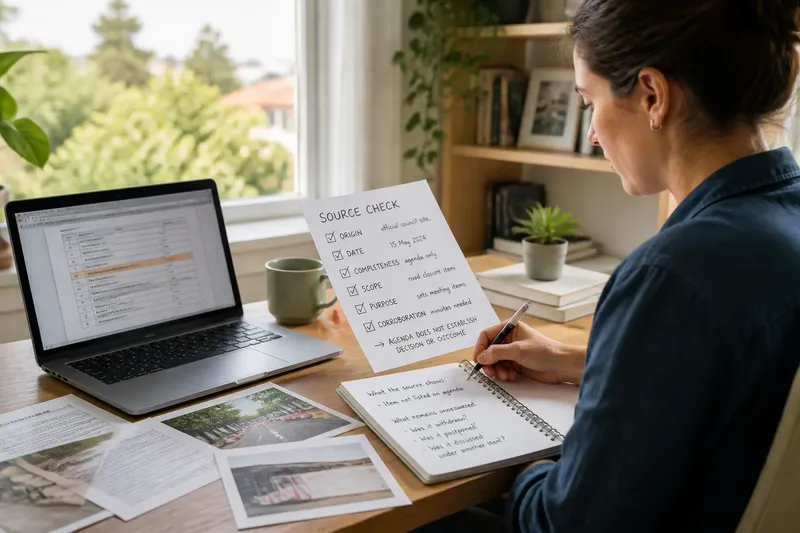
Imagine a fictional local report says a council cancelled a proposed road closure. It links to a meeting agenda that no longer lists the item. The reader follows the link to the council’s agenda page, checks the date and confirms the proposal is absent. They then look for the meeting minutes and find that the agenda alone does not record whether the proposal was withdrawn, postponed or discussed under another item. The result is a specific answer: the agenda does not list the proposal, but the cited source does not establish that the council cancelled it. The reader can report the absence from that agenda and leave the decision open until a record of the meeting or an attributable council statement addresses it.
This approach keeps the source’s value without stretching it. For claim and proof, check the item’s origin, context and scope, then state exactly what it supports. When the source leaves a gap, the honest result is not a louder conclusion but a clearly marked question.