Reading an Early Report Without Rushing to Certainty
Reading an early report carefully helps you tell what an update actually changes, what remains unresolved and what not to repeat as fact.
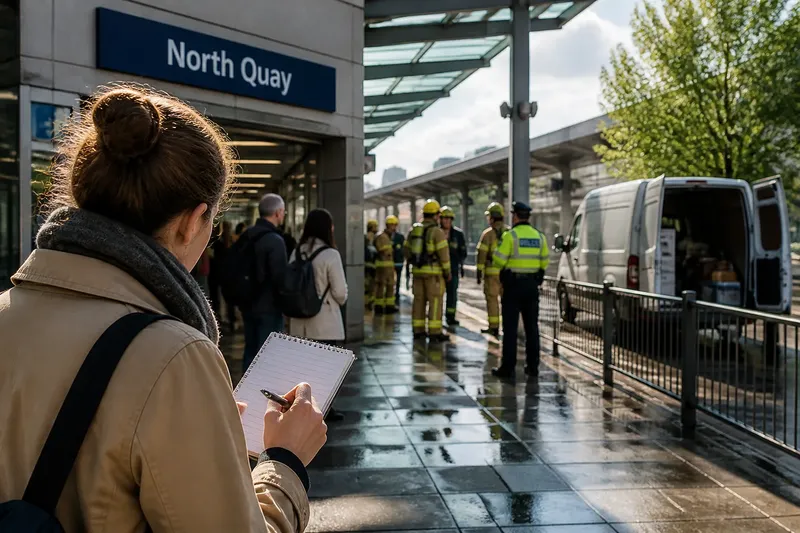
Reading an early report carefully means tracking how the account changes, not merely sorting details into “known” and “unknown”. A local alert about a railway station closure may confirm the disruption while leaving its cause, duration and significance unsettled.
Say a news desk publishes an alert about North Quay station. In this invented situation, the operator says passengers have been moved outside, the fire service says crews are assessing an unusual smell, and no source has been identified. A witness mentions a delivery van nearby. The useful question is what each update adds, rather than which neat explanation the details seem to invite.
What does each update actually change?
Read a developing report as a sequence. An update can change the account of what happened, add information about the response, or simply report what investigators are checking. Those are different kinds of change.
For the North Quay alert, the operator’s statement establishes that passengers were moved. The fire service’s statement establishes that crews are assessing a smell. Neither explains why the station was cleared or whether the smell presented a hazard. A witness’s mention of a van adds a reported detail, but does not connect the vehicle to the incident.
Keep a brief record of the exact wording, its source and its timestamp. If a later notice says the station has reopened, that changes the operational picture. It does not make the first notice inaccurate about the earlier closure.
How can you tell a development from a new explanation?
Look for what the source says has happened, then distinguish it from what the source says may have happened. “Crews are examining a maintenance cabinet” reports an investigative action. “The cabinet caused the smell” gives a cause. The second claim needs its own support.
Verbs carry useful distinctions: “confirmed” reports an established point; “considering” or “suspecting” signals an open possibility; “ruled out” records a later change in the inquiry. Headlines may flatten those differences, so check the body of the report and any linked statement.
In the invented North Quay situation, imagine a later update says crews are checking the maintenance cabinet. If an inspection then rules it out, the account has developed: the inquiry considered one possibility and moved on. That does not mean the earlier report was wrong if it accurately described what crews were checking.
What should you check before repeating an update?
Use these checks to decide what to say, share or leave unresolved:
- Check whether the update names its source. If it attributes the claim to the operator or fire service, repeat that attribution; if it does not, seek the original statement before presenting the claim as established.
- Check the timestamp against the current notice. If the update is current, use it for the present status; if it is old, check the operator’s latest notice before sharing travel information.
- Check whether a statement describes an event or a cause. If it confirms only that passengers were moved, report the evacuation; if it also gives a sourced cause, include that cause with the same qualification.
- Check whether a detail is firsthand or attributed to a witness. If the van is only a witness’s observation, describe it as reported and unrelated unless a reliable account establishes a connection; if no source is given, leave it out.
- Check whether “under investigation” is being treated as a result. If the inquiry is still under way, say what is being examined; if an outcome is later reported, update the account rather than guessing ahead.
- Check whether a correction or newer notice changes an earlier detail. If it does, use the corrected wording and note the change where relevant; if it does not, keep the earlier detail only as historical context.
What should you say when the story is still developing?
Does a closure establish why a station was cleared?
No. It establishes the reported operational change, not its cause. Attribute the closure to the operator’s notice and leave the reason open unless a sourced update explains it.
Does “crews are investigating” make one explanation likely?
Not by itself. It describes an inquiry, so report what crews are examining without turning that activity into a finding.
When should you check for another update?
Check again when a named source is likely to address a specific unresolved point, such as the operator’s current service notice. Repeated posts that merely restate the original alert add little.
How should an early report be shared?
Keep the source and status attached to the claim. “The operator says passengers were moved while crews assess an odour” is more precise than naming a cause the report has not established.
How does a later update alter the account?
Imagine the next update in the invented case says crews traced the odour to a cleaning product in a service area, and the operator says the station has reopened. The account now includes a reported source and a changed service status. If the update does not say whether anyone faced a hazard, that question remains open; a reader should not supply an answer from the reopening alone.
Reading an early report carefully is useful because it lets you revise one part of the account without treating every new detail as a total reversal. A simple analogy helps: updating a route on a paper map changes the route, not the places already marked along it. Keep the old wording only when it explains how the story developed, and use the newest sourced information for what is happening now.